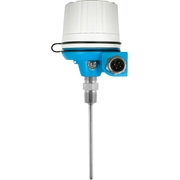
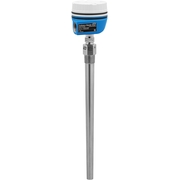
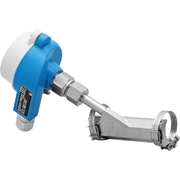
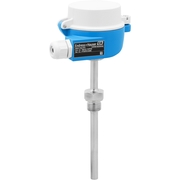
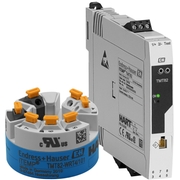
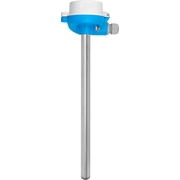
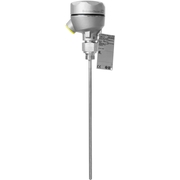
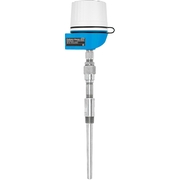
What is a thermocouple sensor and how does a thermocouple work?
Two of the most common sensor technologies in temperature measurement devices are resistance temperature detectors (RTDs) and thermocouples (TCs). The technology behind them is different, and each has its own benefits that drive the choice. In a thermocouple sensor, two different metals are joined together at one end. At this junction, changes in the temperature induce a voltage / electromotive force that is measured. TCs are not measuring an absolute temperature, but the temperature difference between the measuring point (T1) and a reference point (Tref).
TC (thermocouple) temperature measuring principle explained
Benefits
Wide temperature range from -270°C (454°F) to +1820°C (3308°F)
Fast response time, suitable for dynamic temperature measurements
High vibration resistance
Lower cost compared to RTDs
Rugged and durable, especially useful in harsh environments
Thermocouple types The Seebeck effect, which is made use of for TCs, states that a voltage is generated when two dissimilar metals are joined together. The voltage generated can then be measured and converted into temperature readings, using a calibration curve or table. There are different types of thermocouples, based on different wire pairs and measuring ranges. Each type of TC has a unique relationship between the voltage generated and the temperature. The type can be identified by an assigned letter, e.g. TC type K, type J or type T.
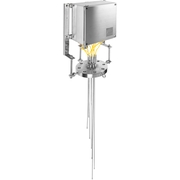
Endress+Hauser has developed a unique sensor called iTHERM ProfileSens for high temperatures, pressures and aggressive media, consisting of a robust double metal sheathed MI cable and temperature profiling with up to four TCs in one cable.
测量精度Class AA acc. to IEC 60751 Class A acc. to IEC 60751 Class B acc. to IEC 60751 Class special or standard acc. to ASTM E230 Class 1 or 2 acc. to IEC 60584-2
响应时间t90 starting at < 1,5 s iTHERM QuickSens depending on configuration
最大过程压力(静压)depending on the configuration
工作温度范围PT100 TF iTHERM StrongSens: -50 °C ...500 °C (-58 °F ...932 °F) PT100 TF iTHERM QuickSens: -50 °C …200 °C (-58 °F …392 °F) PT100 WW: -200 °C ...600 °C (-328 °F ...1.112 °F) PT100 basic TF: -50 °C ...200 °C (-58 °F ...392 °F) Typ K: max. 1.100 °C (max. 2.012 °F) Typ J: max. 800 °C (max. 1.472 °F) Typ N: max. 1.100 °C (max. 2.012 °F)
测量精度Class AA acc. to IEC 60751 Class A acc. to IEC 60751 Class B acc. to IEC 60751 Class special or standard acc. to ASTM E230 Class 1 or 2 acc. to IEC 60584-2
响应时间depending on configuration
最大过程压力(静压)depending on the configuration up to 500 bar
工作温度范围PT100 TF iTHERM StrongSens: -50 °C ...500 °C (-58 °F ...932 °F) PT100 TF iTHERM QuickSens: -50 °C …200 °C (-58 °F …392 °F) PT100 WW: -200 °C ...600 °C (-328 °F ...1.112 °F) PT100 basic TF: -50 °C ...200 °C (-58 °F ...392 °F) Typ K: max. 1.100 °C (max. 2.012 °F) Typ J: max. 800 °C (max. 1.472 °F) Typ N: max. 1.100 °C (max. 2.012 °F)
测量精度depending on application Class AA acc. to IEC 60751 Class A acc. to IEC 60751 Class B acc. to IEC 60751 Class special or standard acc. to ASTM E230 Class 1 or 2 acc. to IEC 60584-2
测量精度Class AA acc. to IEC 60751 Class A acc. to IEC 60751 Class B acc. to IEC 60751 Class special or standard acc. to ASTM E230 Class 1 or 2 acc. to IEC 60584-2
响应时间fastest response time with thermowell t90 starting at below 10 s depending on configuration
最大过程压力(静压)depending on the configuration up to 100 bar
工作温度范围PT100 TF iTHERM StrongSens: -50 °C ...500 °C (-58 °F ...932 °F) PT100 TF iTHERM QuickSens: -50 °C …200 °C (-58 °F …392 °F) PT100 WW: -200 °C ...600 °C (-328 °F ...1.112 °F) PT100 TF: -50 °C ...400 °C (-58 °F ...752 °F) Typ K: max. 1.100 °C (max. 2.012 °F) Typ J: max. 800 °C (max. 1.472 °F) Typ N: max. 1.100 °C (max. 2.012 °F)
工作温度范围K型: -40 C ...1.100 C (-40 F ...2.012 F) J型: -40 C ...750 C (-40 F ...1.382 F) N型: -40 C ...1.150 C (-40 F ...2102 F) S型: 0 C ...1.400 C (32 F ...2.552 F)
测量精度Class AA acc. to IEC 60751 Class A acc. to IEC 60751 Class B acc. to IEC 60751 Class special or standard acc. to ASTM E230 Class 1 or 2 acc. to IEC 60584-2
响应时间t90 starting at < 1,5 s iTHERM QuickSens depending on configuration
最大过程压力(静压)depending on the configuration
工作温度范围PT100 TF iTHERM StrongSens: -50 °C ...500 °C (-58 °F ...932 °F) PT100 TF iTHERM QuickSens: -50 °C …200 °C (-58 °F …392 °F) PT100 WW: -200 °C ...600 °C (-328 °F ...1.112 °F) PT100 TF: -50 °C ...400 °C (-58 °F ...752 °F) Typ K: max. 1.100 °C (max. 2.012 °F) Typ J: max. 800 °C (max. 1.472 °F) Typ N: max. 1.100 °C (max. 2.012 °F)
测量精度Class AA,符合IEC 60751标准 Class A,符合IEC 60751标准 Class B,符合IEC 60751标准 特殊精度或标准精度,符合ASTM E230标准 Class 1或Class 2,符合IEC 60584-2标准
响应时间depending on configuration
最大过程压力(静压)depending on the configuration up to 500 bar
工作温度范围PT100 TF iTHERM StrongSens: -50 °C ...500 °C (-58 °F ...932 °F) PT100 TF iTHERM QuickSens: -50 °C …200 °C (-58 °F …392 °F) PT100 WW: -200 °C ...600 °C (-328 °F ...1.112 °F) PT100 TF: -50 °C ...400 °C (-58 °F ...752 °F) Typ K: max. 1.100 °C (max. 2.012 °F) Typ J: max. 800 °C (max. 1.472 °F) Typ N: max. 1.100 °C (max. 2.012 °F)
测量精度class 2 acc. to IEC 60584 ASTM E230 and ANSI MC 96.1
响应时间depending on configuration: TC: t50 = 2 s t90 = 5 s RTD: t50 = 0,8s t90 = 2s
最大过程压力(静压)at 20 °C: 100 bar (1450 psi)
工作温度范围Type K: max. 1.150 °C (max. 2.102 °F) Type J: max. 920 °C (max. 1.688 °F) Type N: max. 1.150 °C (max. 2.102 °F) Type T: max. 370 °C (max. 698 °F)